

Fitbit Sense vs Versa 4. this If you’re eyeing a new health-smartwatch and spend your wrist-time debating between the Sense and the Versa 4, you’re in good company. These two models from Fitbit share a lot — design heritage, core fitness tracking, battery claims yet they diverge enough that your choice should depend on how deep you want to go into health monitoring, budget constraints, and use case. In this article, I’ll walk you through everything an expert would look at: design & build, displays, comfort, sensors & health features, fitness tracking, smart features, battery & charging, software & ecosystem, value & pricing, and finally a verdict on which one makes more sense for different kinds of users.
Design & Build
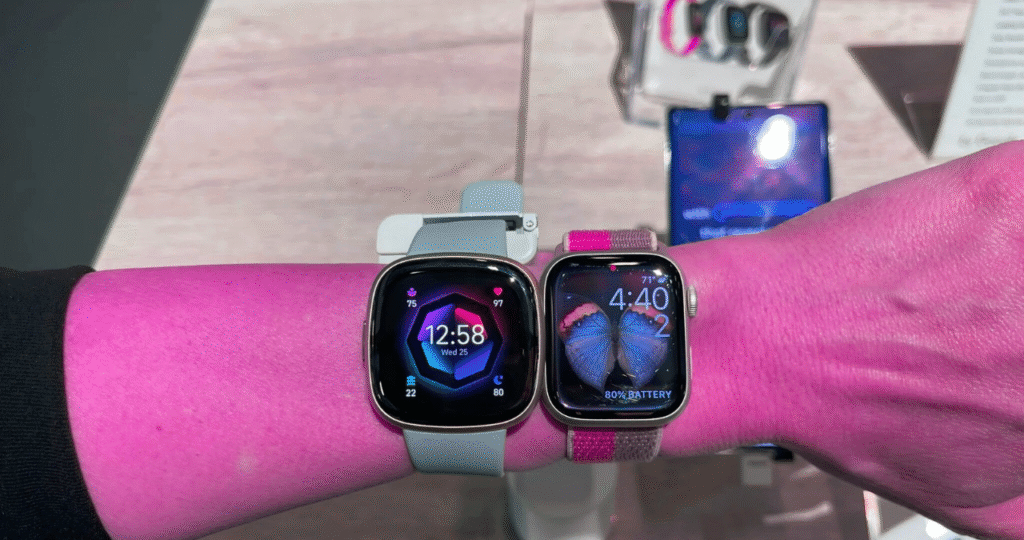
When comparing the Sense and the Versa 4, from a design and build perspective, you’ll immediately notice how similar they are which is good because Fitbit clearly has a winning form factor. Both watches offer a sleek square-ish face (with rounded corners), a metal-cased body, and swappable straps, which makes them feel premium and comfortable enough for daily 24/7 wear.
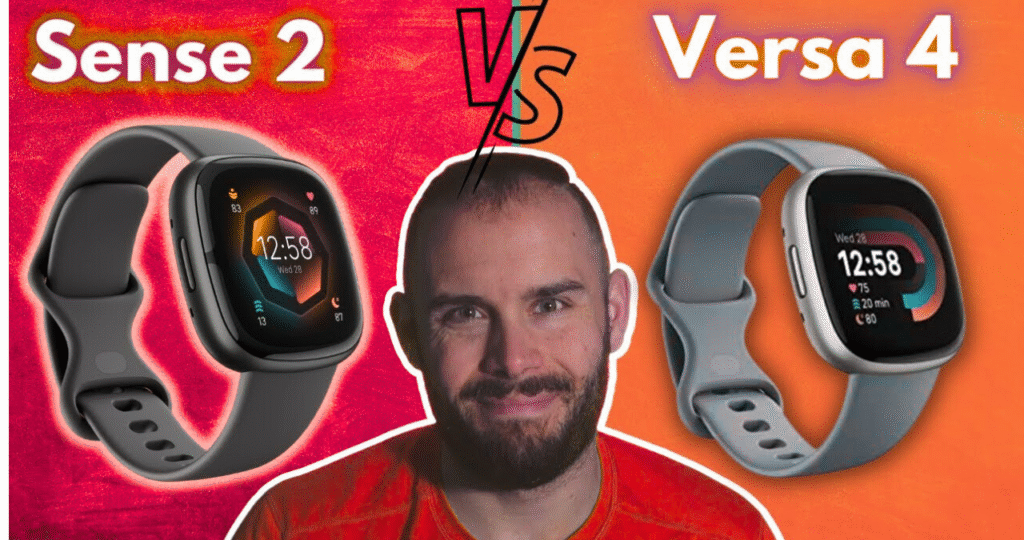
However, digging a bit deeper, you’ll find some subtle but meaningful differences. The Versa 4 tends to be positioned more as the “fitness-tracker turned smartwatch” choice, while the Sense leans more toward “wellness & health monitoring” and that shows up in build cues like muted vs more energetic colour-ways, and minor differences in sensor housing and finishing. Reviews say that the Versa 4 colours (like “Waterfall Blue”, “Copper Rose”) are a little more playful, while the Sense opts for more muted palettes (e.g., “Shadow Grey”, “Lunar White”) that emphasise the premium wellness angle.
Fit and comfort-wise, either will do. The strap sizes match, and the thickness and weight seem nearly identical in hands-on reviews. One softness point: if you tend to wear your watch at night for sleep tracking, the finish, strap texture, and how the body sits on your wrist might matter. Some users report that the Versa 4 feels a touch lighter/less bulky (though not always significantly so) compared to earlier Sense versions. Forums mention that while the Sense (original) had extra sensors/bulge, the Versa 4 was described as “thinner and lighter” relative to earlier Sense models.
In short, if you care about how it looks and how it fits, both are strong, but you might prefer the style-finish of one over the other, depending on your taste.
Display & User Interaction
Both the Sense and the Versa 4 use a sharp OLED/AMOLED display (depending on region/configuration) with good resolution, bright colours, and good outdoor visibility. According to specs, they share a 1.58-inch 336×336 resolution display.
The fact that both share the same display size means from a user-experience angle, you won’t feel the “Sense looks better” purely because of screen tech; the differentiator comes from UI design, watch-face options, and how the hardware feels in your hand (or on your wrist).
User interaction improvements: both watches have moved away from finicky capacitive side controls (as in earlier generations) toward a more reliable physical side button combined with the touch-screen. Reviews note Fitbit “nailed the design” in this respect.
One nuance: in a head-to-head review, the Versa 4’s screen sensors were found slightly more responsive (e.g., flick-wrist to wake) than the Sense in that sample. That may reflect firmware or individual unit variance, but for your decision, it means: either display is excellent; you won’t lose out on readability or sharpness with the “cheaper” of the two.
If you care about always-on display (AOD) or night-time clarity, you might want to check real-world battery drain (more on that below), because more display usage typically impacts endurance.
Sensors & Health-Monitoring Features
Here is where your decision begins to get serious: what do you want to monitor and how deeply? On this front, the Sense pulls ahead (or is designed to pull ahead) with extra sensors that cater to health-conscious users, while the Versa 4 focuses more on core tracking.
What they share
Both watches handle the basics very well: ActiveZone Minutes, optical heart rate, SpO₂ monitoring, built-in GPS (so you can leave your phone behind while running), water-resistance (50 m/5ATM) for swim tracking, standard sleep tracking, and so on.
If you’re simply after a reliable daily tracker of steps, workouts, sleep, and heart rate, and you’d also like GPS, they both deliver.
Where Sense goes further
The Sense model (especially the newer iteration if you compare Sense vs Sense 2, etc.) adds advanced sensors such as:
- ECG (electrocardiogram) capability: this allows you to record your heart rhythm to check for irregularities.
- EDA/cEDA (electrodermal activity) sensor: this is used for stress tracking by measuring tiny changes in skin conductance (sweat, etc) and thus giving you more insight into your stress load.
- Skin-temperature sensor: which can add context to your sleep, readiness, and possibly indicate early signs of illness or cycle changes.
In other words, if you care about holistic health stress, temperature changes, heart-rhythm irregularities the Sense gives you more tools. One reviewer put it succinctly:
“While both the Sense 2 and Versa 4 are big on health and wellbeing… the Sense 2 boasts two features that are missing from the Versa 4: an ECG and EDA scan.”
The caveats
- Having the sensors is one thing; using them effectively is another. If you never look at your “stress score” or you don’t open the ECG app, then those extra sensors don’t bring much value.
- Extra sensors can mean heavier battery usage (especially if you keep them always active). Some reviews note that the “extra health depth” comes at a slight cost.
- Some health features depend on region/certification (for ECG, etc), so check whether your country is supported.
My takeaway: if you are serious about health monitoring (heart-health, stress, recovery), then Sense is the better pick. If you’re more into activity, workouts and general wellness, the Versa 4 gives you most of what you need at a lower cost.
Fitness & Activity Tracking
Tracking your workouts, steps, runs, swims, etc this is where the Versa 4 arguably shines. It positions itself as the fitness-first model.
Workout modes and tracking
The Versa 4 comes loaded with “over 40 exercise modes” (running, weights, HIIT, swimming, yoga, kayaking, etc) and built-in GPS so you don’t always need to carry your phone.
It’s well-suited for someone who hits the gym often, tracks multi-sport workouts, or wants quick-access workout logging without fuss.
How Sense performs
Sense covers all the same base modes (steps, running, swimming, gym, etc) because Fitbit uses the same tracking foundations. But its “extra” edge is more in the recovery-/wellness side: tracking how ready your body is, stress recovery, etc. So if you’re someone who monitors workouts plus recovery, the Sense model gives you a fuller picture.
GPS and accuracy
Reviews note that both watches have built-in GPS, and that’s a big plus. But some mention that the Versa 4’s GPS locking/tracking can be a little slower or less refined than dedicated sports watches (or than what you might expect from a premium tracker).
For most daily uses, the GPS is fine. For serious competitive athletes or ultra-distance runners, you might want to compare with a dedicated running watch.
Fitness focus vs wellness focus
If your primary goal is “log workouts, hit goals, monitor performance”, then the Versa 4’s fitness-centric stance may appeal more. If your goal is more holistic “I want to understand not just how much I train, but how I recover, how ready I am, how stressed I am, how my body is doing” then the Sense brings more nuance.
In short: Versa 4 = workout-focused; Sense = wellness + workout.
Smartwatch Features & Ecosystem
Beyond sensors and fitness, the smartwatch features (notifications, calls, apps, payments, compatibility) are important.
Shared smart features
Both watches provide the basics: smartphone notifications, answering calls (when paired to a compatible phone), text messages, and calendar alerts. They also support on-wrist calling via Bluetooth if your phone is nearby.
They provide built-in GPS, water-resistance, and Fitbit’s app ecosystem, including Fitbit Premium (trial) for deeper insights.
Differences/things to check
One of the criticisms raised by users: the app ecosystem on Fitbit watches is more limited compared to full Wear OS smartwatches (or Apple Watch). In a community post, a user noted, for example:
“No third-party apps on Versa 4.”
Also: music storage/control on the wrist is less advanced than some competitor watches, meaning you might still need your phone for some features (depending on region/version). One review points this out for both watches.
Payment/Wallet & maps
Both watches now support Google Wallet and Google Maps (depending on region) for turn-by-turn directions and contactless payments.
From a smartwatch standpoint, you won’t get as many apps or full customisation as an Apple Watch or top-tier Wear OS device, but for many users, the feature set is quite sufficient.
Which is “smarter”?
Since the hardware and ecosystem overlap so much, the difference isn’t huge. Both offer strong smartwatch features. If you expect lots of app downloads, custom third-party tools, or offline music storage, you might feel limited. But if you want solid notifications, fitness tracking, smart payments, maps, and a polished interface, both deliver.
Sense might feel slightly more premium in smart-feature polish (driven by its higher price and wellness focus), but for many users, the Versa 4 will be “smart enough”.
Battery Life & Charging
Battery life is always a key concern for smartwatches especially when you’re tracking workouts, sleep, GPS, and health sensors 24/7.
Claims & real-world
Fitbit advertises six days or more of battery life on both Sense and Versa 4 under typical usage.
Reviews confirm that in moderate use (no always-on display, moderate GPS), both watches often hit near that 6-day mark. For example, one review said:
“Even when I had enabled GPS … both the Sense 2 and Versa 4 hit the six-day mark and even beyond when I used the watch without GPS functionality.”
The trade-offs
- If you turn on always-on display (AOD), use GPS heavily, or enable all sensors (stress monitoring, temperature tracking), then battery life will drop.
- The Sense, due to extra sensors (ECG, cEDA, skin temperature), might draw more power in some scenarios than the Versa 4. Indeed, one article notes: “Although the Sense 2 is the better watch… the cheaper model (Versa 4) holds its own… cheaper price.”
- Charging time: both watches recharge fairly quickly (around 2 hours to full according to specs), and many users say a short 12-minute top-up can give a day’s worth of battery (though this varies).
What to expect
If you’re a heavy user (GPS every run, sleep + stress tracking, always-on display), expect maybe 3-5 days between charges. If you’re moderate (notifications, some workouts, day use), then 5-6 days is realistic. In that sense, both devices are solid compared to many smartwatches, which need daily/2-day charging.
If you were doing the math, the cost savings of going for Versa 4 might make sense if you’re comfortable with a “good enough” battery. If you pick Sense for its extra sensors, you might accept slightly less battery or be more diligent about charging.
Software, Updates & Ecosystem Longevity
When buying a smartwatch, you should care not just about the hardware today but about how well maintained it will be over time OS updates, sensor support, app ecosystem, longevity.
Fitbit ecosystem
Fitbit (now part of Google) has a strong base of users, a mobile app, and a health tracking infrastructure. The firmware and app updates aim to add features over time. For example, new workout modes, improved readiness features, and new watch faces.
Reviews of the Sense vs Versa 4 note that both run “the same OS” (for the most part) and share many of the same updates, which is good.
Support & considerations
- Because Sense and Versa 4 share the launch era, the longer you wait, the more you should consider how many years of support remain.
- Some users on forums express concern about missing features or delays (e.g., third-party apps on Versa 4).
- One article noted that although Sense is “a better watch… is it a better buy?” in part because of the price vs feature trade-off.
Ecosystem interplay
If you already own other Fitbit devices (scale, tracker, etc), then sticking with Fitbit makes sense for synergy. Also, if you have an Android phone (especially a Google ecosystem), then compatibility tends to be strong. On iOS, the experience is good, but some deeper sensor features or readiness scores might feel more tailored to Android.
Value & Pricing
Budget always plays a role. While exact local pricing in Pakistan may vary, the global positioning of the two models gives a sense of relative value.
The Versa 4 is priced lower (targeted as a more affordable fitness-smartwatch) while the Sense carries a premium price because of its extra health/sensor features. Several reviews stress that while the Sense is “better” in specs, the Versa 4 “hits the sweet-spot” for most users who don’t need ECG/EDA.
From a value viewpoint:
- If you get the Versa 4 at a good discount, you may gain 90-95% of what most users need, at maybe 70-80% of the cost of the Sense.
- If you pick the Sense, you pay extra for “depth” of health monitoring worth it only if you will use it. If you wouldn’t regularly leverage ECG/EDA/skin-temperature tracking, then you may not justify the cost difference.
One review conclusion:
“I’d recommend the Versa 4 for most people… I don’t use the Sense 2’s heart-health and stress-related features… but if you can find a deal that brings the Sense 2 price close to Versa 4, then it might be worth it.”
In the Pakistani market, you’ll want to check import duties, warranty support, local-service availability, and whether all sensor features are supported in your region (ECG/EDA may depend on local regulation). All that affects value.
Pros & Cons Summary
Versa 4 – what it does well
Pros
- Strong value: lots of features for the price.
- Excellent fitness tracking: many workout modes, built-in GPS, good strap comfort.
- Solid display, good build, good battery for everyday use.
- Less cost to “enter” the Fitbit smartwatch ecosystem.
Cons
- Fewer advanced health sensors compared to Sense (no ECG/cEDA/skin-temp).
- The smartwatch/app ecosystem is still not as rich as the top competitor watches.
- If you want the “deepest” wellness monitoring, you may feel it lacks some pieces.
Sense – what it does well
Pros
- Premium wellness/health monitoring: ECG, EDA/cEDA, skin-temp sensors more data.
- Same foundation of display/build/fitness tracking as Versa 4 in many respects.
- Great if you want a “lifestyle wellness” watch, not just a fitness band.
Cons
- Higher cost.
- Some users may never use all the extra sensors and so pay for features they don’t need.
- Slightly more complexity (you’ll want to dig into the sensor data to get value).
- If battery use is heavy (due to extra sensors), you might see slightly less endurance.
Which Should You Choose?
Here’s a practical guide based on user types.
- You are primarily a workout enthusiast: running, gym, HIIT, tracking progress, but you don’t stress about deep wellness metrics like heart-arrhythmia, skin-temp, or stress tracking. Pick Versa 4. It will give you what matters most, without paying extra for features you won’t use.
- You are wellness-focused: you care about how stressed you are, how your recovery is, your heart health, and you want sophisticated data about how your body is doing beyond workouts. Pick Sense. The extra sensors justify the price.
- Your budget is tight: go with Versa 4 you’ll still get a great experience.
- You want future-proofing and might leverage sensors: Sense may give you a bit more longevity in terms of what you can measure.
- You’re in a region where certain features aren’t supported: check whether ECG or EDA sensors work in your country. If they don’t, maybe the “premium” advantage of Sense is reduced.
Final Verdict
After digging into design, display, sensors, fitness features, smart features, battery, value my expert opinion is this:
For most users, the Versa 4 hits the sweet spot. It offers excellent fitness tracking, good smart features, a strong battery, and a comfortable build at a more accessible price. Unless you have very specific needs (for example, you have a heart-health condition or you track stress & recovery as part of your business/lifestyle), you’ll be more than satisfied with the Versa 4.
If, however, you are someone who cares about the deeper metrics wanting ECG, skin-temperature, stress monitoring via EDA then the Sense is worth the extra investment. In that case, it’s not just “a little better”; it offers capabilities that the Versa 4 lacks.
In short:
- Versa 4 = smart fitness watch for the many.
- Sense = premium wellness & health watch for those who dig deeper.
Choose the one that matches how you’ll actually use it, rather than the one with the biggest spec sheet. Wrist real estate is finite, so picking the one you’ll wear and use every day matters more than a few extra sensors you’ll ignore.