
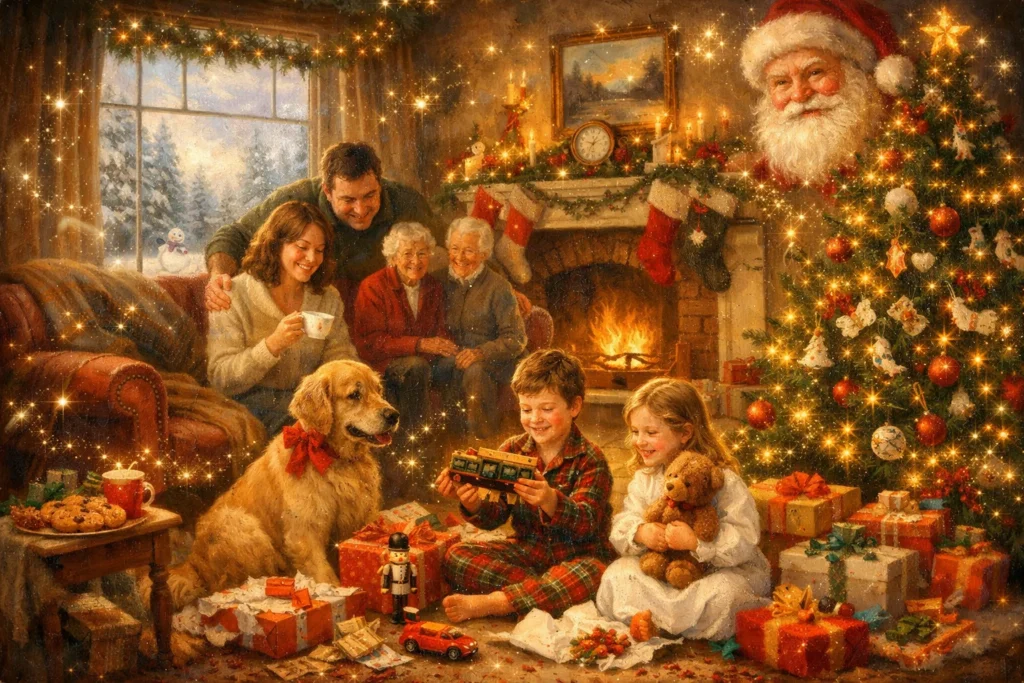

Happy Christmas Day,The phrase “Happy Christmas Day” evokes more than just a date on the calendar. It conjures a symphony of sensory memories—the scent of pine and cinnamon, the warm glow of fairy lights against a winter window, the chorus of familiar carols, and the profound feeling of connection that seems to amplify as the year draws to a close. But beneath the wrapping paper and festive feasts lies a rich tapestry of history, tradition, and universal human yearning for light, hope, and togetherness. This deep-seated desire for peace and goodwill is the true engine of the season, transforming a simple greeting into a powerful wish for profound joy. To explore this day is to unpack centuries of cultural evolution, to understand why certain symbols resonate so deeply, and to rediscover the timeless recipes for creating genuine, lasting happiness that extends far beyond material gifts. Our journey through the essence of a truly Happy Christmas Day begins not in a shopping mall, but in the ancient past, where winter itself was a challenge to be met with community and light.
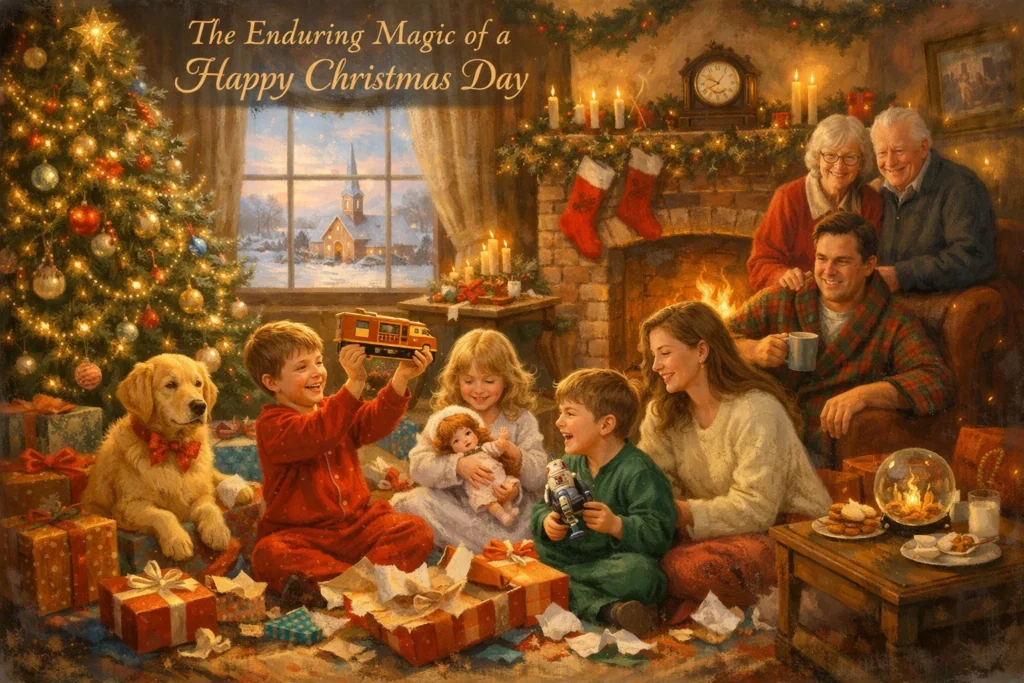
The Ancient Roots of a Winter Celebration
Long before the Nativity story shaped the holiday, ancient cultures across the Northern Hemisphere marked the winter solstice. This pivotal astronomical moment, the longest night of the year, was a time of both fear and hope. People feared the weakening sun might not return, threatening survival. In response, they created rituals to summon back the light and ensure fertility for the coming spring. The Norse celebrated Yule, feasting for twelve days as the sun began its slow return, burning a massive Yule log to symbolize warmth and light conquering darkness. In Rome, the festival of Saturnalia turned social norms upside down with revelry, gift-giving, and masters serving slaves, all in honor of Saturn, the god of agriculture and time.
These pagan traditions planted the seeds for what we now recognize as Christmas customs. The emphasis on light (candles, fires), feasting, charity, and temporary social equality provided a familiar cultural framework. When the Christian church sought to establish a date for celebrating the birth of Jesus, aligning it with these existing, deeply ingrained solstice celebrations was a strategic and meaningful choice. It allowed the new spiritual narrative of “the Light of the World” entering darkness to overlay the older, cosmological celebration of the sun’s return. Thus, the foundation for a Happy Christmas Day was laid, merging the human instinct to celebrate returning light with a profound story of divine hope and renewal.
The Historical Journey to December 25th
The selection of December 25th as the official date for Christmas was not immediate. Early Christians focused far more on Easter, the celebration of the resurrection. The exact date of Jesus’s birth is not recorded in the Gospels, leaving it open to interpretation. By the early 4th century, however, church leaders in Rome began to formally observe December 25th. This date was likely chosen for two synergistic reasons: to provide a Christian alternative to the popular Roman festivals of Saturnalia and the feast of Dies Natalis Solis Invicti (the Birthday of the Unconquered Sun), and to theologically align the conception of Jesus with his death. An ancient belief held that prophets died on the same date as their conception; with Easter calculated around March 25th, December 25th naturally followed as the birth date.
The celebration spread, but its character varied wildly for centuries. In medieval England, Christmas became a lengthy season of “Christmastide,” stretching from December 24th to Epiphany on January 6th. It was less a silent night and more a boisterous, public festival of wassailing, mummers’ plays, and communal feasting in great halls. The Puritan movement in both England and colonial America, however, outright banned Christmas in the 17th century, deeming its merrymaking pagan and wasteful. The holiday’s survival and eventual dominance as a family-centered, gift-giving event is a testament to its powerful cultural adaptability and the deep human need for the warmth and cheer it promises in the heart of winter.
The Victorian Reinvention of Christmas
The image of a “traditional” Happy Christmas Day—with a decorated tree, gift-giving, carolers, and a jolly Santa Claus—is largely a product of the 19th century, specifically the Victorian era. Two key figures in Britain catalyzed this transformation: Queen Victoria and her German-born husband, Prince Albert. When an illustrated newspaper showed the royal family gathered around a decorated Christmas tree at Windsor Castle in 1848, a craze was born. The German tradition of the Tannenbaum became an essential symbol of a proper British, and later American, Christmas, representing evergreen life and family unity.
This period also saw the publication of Charles Dickens’s A Christmas Carol in 1843. Dickens’s tale of Ebenezer Scrooge’s redemption did not invent Christmas charity, but it powerfully articulated the “Christmas spirit” as one of compassion, generosity, and familial joy, especially for the poor and vulnerable. The Victorian era codified the Christmas card, the Christmas cracker, and the emphasis on a bountiful family dinner. It shifted the holiday’s focus from rowdy public celebration to a sentimental, domestic, and child-centered occasion, creating the nostalgic template for the cozy, family-oriented Happy Christmas Day we still strive to create.
The Global Tapestry of Christmas Traditions
While the core themes of light, family, and generosity are universal, the expression of a Happy Christmas Day varies beautifully around the globe, reflecting local culture and history. In Ethiopia, where Christianity is ancient, Christmas (Ganna) is celebrated on January 7th with a day of fasting followed by a spectacular feast and a game resembling field hockey. In Venezuela, a unique tradition sees families roller-skating to early morning Christmas Mass in Caracas, with streets closed to cars to allow for the joyful procession. These diverse customs highlight how the holiday adapts to local rhythms and sensibilities.
In the Philippines, home to the world’s longest Christmas season, festivities begin in September with the “Ber Months.” The celebration peaks with Simbang Gabi, a series of nine dawn masses leading up to Christmas Day, followed by a grand family feast (Noche Buena). Conversely, in Japan, where Christians are a minority, Christmas has been adopted as a secular, romantic holiday akin to Valentine’s Day, marked by festive illuminations and the iconic Christmas Eve date night, with a surprising national tradition of enjoying Kentucky Fried Chicken. This global mosaic shows that a Happy Christmas Day is not a monolithic experience but a flexible concept of joy shared across cultures.
The Psychology of Christmas Cheer and Connection
What is it about Christmas that can simultaneously lift our spirits and, for some, induce stress? Psychologically, the season taps into deep-seated needs for belonging, tradition, and meaning. Rituals, from decorating the tree to baking specific cookies, provide a sense of predictability and control, reducing anxiety and strengthening family identity. The act of gift-giving, when done thoughtfully, activates the brain’s reward centers for both giver and receiver, fostering social bonds and expressing love tangibly. This neurochemical boost is a key ingredient in the recipe for a Happy Christmas Day.
However, the “ideal” Christmas portrayed in the media can create a cognitive distortion known as the “Pollyanna fallacy,” setting unrealistic expectations for perfect harmony and joy. The pressure to spend, host, and perform happiness can lead to significant stress, overshadowing the simpler pleasures. The key to psychological well-being during the season lies in managing expectations, focusing on the quality of connections over the quantity of gifts, and permitting imperfection. Embracing the authentic, sometimes messy, moments of togetherness often leads to a more genuinely Happy Christmas Day than any curated social media post could capture.
The Signature Flavors of the Christmas Feast
The Christmas meal is a centerpiece of celebration, a sensory anchor that ties generations together through taste and aroma. These dishes are far more than sustenance; they are edible history and expressions of love. In many cultures, the feast features rich, hearty, and often preserved foods that historically showcased prosperity during the lean winter months. The British Christmas table, for instance, is defined by its roasted turkey or goose, accompanied by savory stuffing, roasted potatoes, pigs in blankets, and the essential bread sauce, a creamy, spiced condiment with medieval origins.
Desserts often carry even deeper symbolic weight. The Italian panettone, a sweet bread studded with fruits, represents the bounty of the harvest. The German stollen, dusted in powdered sugar, is said to symbolize the Baby Jesus in swaddling clothes. The English Christmas pudding, stirred by the whole family while making a wish, is doused in brandy and set aflame, a dramatic spectacle of light conquering darkness. Preparing and sharing these specific, once-a-year foods creates a powerful multisensory memory, making the taste of a mince pie or the smell of mulled wine a direct pathway to the feeling of a Happy Christmas Day.
The Evolution of Christmas Gift-Giving
The tradition of exchanging gifts at Christmas has a complex lineage, weaving together threads from Saturnalia, the Biblical story of the Magi, and folk legends. For much of history, gifts were modest—fruits, nuts, handmade trinkets, or “Christmas boxes” of money or food given to servants and tradespeople on December 26th (Boxing Day). The shift to the elaborate, wrapped presents under a tree was a gradual process supercharged by the Victorian era’s sentimentality and the 20th century’s consumer economy. The iconic figure of Santa Claus, evolving from the Dutch Sinterklaas and the British Father Christmas, became the central agent of this gift-giving magic.
Today, gift-giving exists on a spectrum. At its worst, it can become a stressful, commercial obligation. At its best, it is a profound language of care. The psychological principle of “reciprocity” is powerful, but the most meaningful gifts often bypass mere monetary value. They demonstrate thoughtful observation—a book on a niche interest, a handmade item, an experience shared. The modern movement towards “consumption-less” gifts—donations to charity in a loved one’s name, promises of time together, or homemade coupons for services—reflects a growing desire to recapture the intentional spirit behind the gesture. This mindful approach can recenter the practice as an expression of love, not commerce, contributing to a more balanced and Happy Christmas Day.
The Iconic Sounds and Sights of the Season
The atmosphere of Christmas is powerfully constructed by its sensory landscape. Musically, carols hold a unique place. From solemn hymns like “O Come, All Ye Faithful” to cheerful ditties like “Jingle Bells,” this music forms a shared cultural soundtrack that triggers immediate nostalgia and emotion. Studies suggest that familiar Christmas music can release dopamine, but also that overexposure in commercial spaces can lead to irritation—a fine line between cheer and fatigue. The tradition of community caroling itself is an act of sharing this auditory joy, bringing music directly to neighborhoods and fostering a sense of communal connection.
Visually, the symbolism is equally potent. The Christmas tree, an evergreen adorned with lights and ornaments, is a universal symbol of enduring life and light in darkness. The star or angel atop it echoes the Bethlehem Star. Christmas lights, originally candles, now illuminate homes and cities in spectacular displays, literally pushing back the winter night and creating public joy. Even the colors of Christmas—red (for the blood of Christ, or Santa’s robes), green (for eternal life), gold (for light and royalty), and white (for purity and snow)—carry layered meanings. This coordinated sensory experience immerses us in the season, making the world feel temporarily transformed and magical, setting the stage for a Happy Christmas Day.
Navigating Modern Challenges and Finding Balance
The contemporary Christmas season, while filled with potential for joy, also presents distinct challenges. The overwhelming commercial pressure, amplified by relentless advertising and social media comparison, can create financial strain and a feeling of never doing “enough.” The logistical demands of travel, hosting, and coordinating family dynamics can be exhausting. For those who have experienced loss, grief can feel magnified against the backdrop of mandated merriment, a phenomenon often called the “holiday blues.” Acknowledging these pressures is the first step toward a healthier celebration.
Achieving a balanced and genuinely Happy Christmas Day requires intentional boundary-setting. This might mean establishing a gift budget or implementing a drawing for names in large families. It could involve consciously scheduling quiet, restorative moments amidst the frenzy or creating new traditions that honor a lost loved one. The concept of “Julehygge,” the Danish/Norwegian emphasis on cozy, comforting togetherness, offers a helpful antidote to seasonal stress. By prioritizing presence over presents, connection over perfection, and simple rituals over extravagant performances, we can reclaim the season’s essence and protect our own well-being.
Crafting Your Own Meaningful Christmas Experience
Ultimately, the most resonant Happy Christmas Day is one that aligns with your personal values and circumstances. This requires moving beyond autopilot traditions and asking what truly brings meaning and connection to you and your loved ones. For some, that may mean volunteering at a community dinner. For others, it could be a quiet day of movies and takeout, or an adventurous trip to escape the ordinary entirely. The goal is to be the author of your own holiday narrative, not an actor following a generic script.
Start by reflecting on your fondest Christmas memories. Often, they involve simple moments of laughter, a sense of belonging, or a feeling of peace—not the “perfect” gift or meal. Use those insights to design your celebration. Perhaps the new tradition is a family hike on Christmas morning, a game night, or a commitment to write heartfelt letters instead of buying gifts. Embracing flexibility is also key; if a blizzard cancels travel, a video call celebration can still be filled with love. By focusing on the core human needs for connection, reflection, and joy, you can build a Christmas day that is authentically and sustainably happy, regardless of external pressures or expectations.
Table: The Two Sides of Christmas Traditions – Pressure vs. Purpose
TraditionPotential for Pressure & StressPathway to Purpose & Connection
Gift-Giving: Financial strain, anxiety over finding the “perfect” gift, commercialism, clutter. Focus on thoughtful, experiential, or homemade gifts. Implement spending limits or gift exchanges. Emphasize the act of giving as an expression of love and knowing the recipient.
The Christmas Feast: Exhausting preparation, cost, pressure for culinary perfection, and family tensions at the table. Make it a potluck to share labor. Simplify the menu to favorite dishes only. Focus on the shared experience of cooking together or the gratitude of the meal itself.
Decorating is Time-consuming, costly, and pressure to match societal or social media “aesthetics.” Decorate gradually as a family activity. Use meaningful ornaments that tell your story. Prioritize cozy, simple lighting over elaborate displays.
Social Obligations: A crammed calendar of parties, feeling obligated to attend everything, and social exhaustion. Politely decline some invites. Prioritize the gatherings most important to you. Host a simple, low-key open house instead of multiple events.
Creating “Magic”: The burden to create a flawless, movie-perfect experience for children, leading to parental burnout. Kids remember feelings, not perfection. Focus on one or two simple, joyful rituals (reading by the tree, looking at lights). Authentic joy is more magical than any production.
As the historian and author Lucy Worsley once noted, “The history of Christmas is a history of humans trying to create light in the darkness, warmth in the cold, and community in a sometimes isolating world.” This elegant observation cuts to the heart of the matter. Our modern debates and stresses about the holiday are simply the latest chapter in an ancient, deeply human story. The trappings change—from Yule logs to LED lights, from wassail bowls to eggnog lattes—but the fundamental drive remains: to gather, to share, to hope, and to kindle joy against the winter gloom. This enduring purpose is what allows the celebration to evolve yet remain perennially relevant.
In the end, a truly Happy Christmas Day is not a destination arrived at through flawless execution of a checklist. It is a feeling cultivated in the small, intentional spaces between the obligations. It’s in the quiet moment of contentment after the meal, the shared laugh over a botched recipe, the warmth of a hand-held during a carol, or the peace of a silent night under winter stars. It is a day that invites us to practice the very virtues it celebrates: generosity without expectation, kindness to both stranger and kin, and a grateful heart. However you choose to mark the day—whether in a crowded church, a bustling family home, or in quiet solitude—may it connect you to that ancient, hopeful light and bring you genuine peace and renewal. That is the deepest wish contained within the simple, powerful greeting: Happy Christmas Day.
Frequently Asked Questions
What is the true history behind saying “Happy Christmas Day”?
The greeting “Happy Christmas” has been common in Britain since the 19th century, with “happy” denoting feelings of blessedness, contentment, and good fortune. It is a direct wish for the recipient to experience the joy, peace, and communal spirit associated with the celebration. Using “Happy Christmas Day” specifically emphasizes a wish for joy on the very day of the feast itself, focusing on the immediate experience of tradition, family, and reflection.
How can I reduce stress and focus on joy during the Christmas season?
To cultivate a more genuinely Happy Christmas Day, shift your focus from performance to presence. Set clear budgets and boundaries around gifts and hosting. Simplify traditions that cause more stress than joy, and don’t be afraid to say no to excessive social obligations. Most importantly, prioritize activities that foster real connection—like playing games, sharing stories, or volunteering together—over those aimed at creating a picture-perfect facade.
Why do traditions like trees and gift-giving define a modern Happy Christmas Day?
Many iconic traditions were popularized during the Victorian era and serve symbolic purposes that resonate deeply. The evergreen tree represents enduring life and hope in winter’s depths. Gift-giving, inspired by the Magi and ancient festivals, is a tangible language of love and generosity. Together, these rituals create a familiar, multisensory framework that marks the time as special, building anticipation and a shared sense of participation in the season’s magic, which is central to the collective experience of a Happy Christmas Day.
How is Christmas celebrated differently around the world?
Global celebrations reveal the holiday’s incredible adaptability while sharing core themes. In Ethiopia, it’s a solemn religious feast (Ganna) on January 7th. In Japan, it’s a romantic secular date night often featuring KFC. In Venezuela, many attend mass on roller skates. In the Philippines, the season starts in September with dawn masses. Each culture layers its own customs onto the holiday, proving that a Happy Christmas Day can be expressed through countless unique yet universally joyful traditions.
What are some meaningful, non-commercial ways to celebrate?
To center a non-commercial Happy Christmas Day, focus on experiences, acts of service, and handmade gestures. Give the gift of time through shared activities or homemade “coupon” books for services. Bake treats for neighbors or local first responders. Volunteer as a family at a food bank or shelter. Host a simple potluck focused on conversation, or take a reflective family walk to admire neighborhood lights. These actions build connection and memories far beyond any store-bought item.
You May Also Read
The Ultimate Guide to Colcampus: Unifying the Digital Learning Ecosystem